
Blister Copper
Product Description
Blister copper is a partially purified form of copper, typically containing 98.5–99.5% copper by weight. It is produced during the smelting of copper ores, where the matte (a mixture of copper, iron sulfide, and other elements) is further refined in a converter furnace. Blister copper gets its name from the blister-like appearance on its surface, caused by the escape of sulfur dioxide gas during the refining process.
Applications
Blister copper is used as an intermediate product in the production of high-purity copper cathodes. It is further refined through electrorefining or fire refining for applications in electrical wiring, plumbing, roofing, and the manufacturing of industrial machinery and electronics.
Appearance
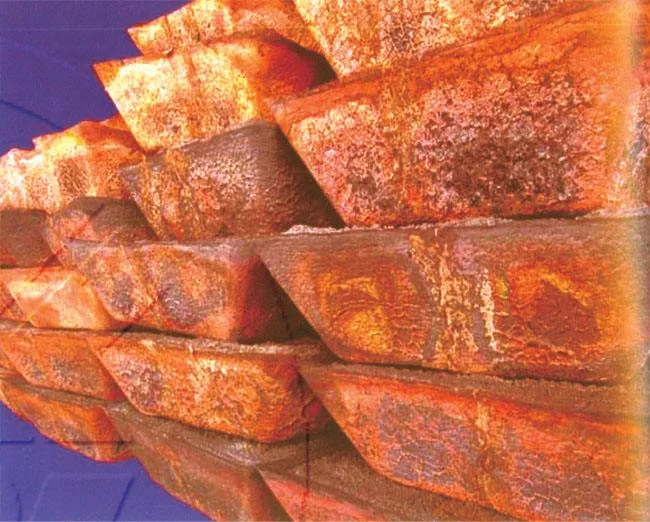
Blister copper typically has a dull, blistered surface with a reddish-brown to dark brown colour. It is usually cast into large slabs or ingots.
Physical Properties
Physical Properties
Technical specifications
| Melting Point | 1,083°C (1,981°F) |
|---|---|
| Boiling Point | 2,562°C (4,644°F) |
| Density | 8.9 g/cm³ |
| Brinell Hardness | 35 HB |
| Tensile Strength | 210 MPa |
| Chemical Properties | |
|---|---|
| Copper (Cu) | 98.5–99.5% |
| Iron (Fe) | 0.2–0.5% |
| Sulfur (S) | 0.03–0.5% |
| Oxygen (O) | 0.3–0.7% |
| Other Impurities (As, Sb, Bi, Pb, Ni) | <0.5% combined |